

The world's first solid-state battery enabling over 1,000 km of range on a single charge has been successfully tested in a real vehicle, marking a breakthrough by the Nankai University research team!
Background knowledge
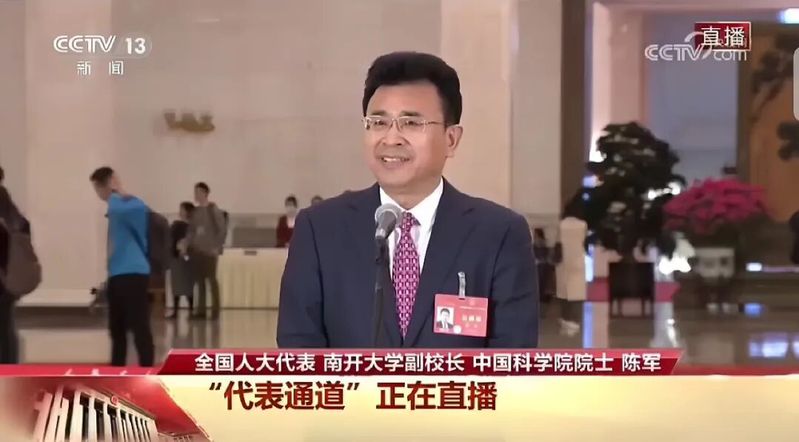
The second Deputies' Passage interview session of the Second Session of the 14th National People's Congress was held at the Great Hall of the People, where Chen Jun, a deputy to the National People's Congress, Vice President of Nankai University, and academician of the Chinese Academy of Sciences, was interviewed. Chen Jun introduced that he and his team have already developed a solid-state battery with an energy density of 400 watt-hours per kilogram, which exceeds the energy density of the most advanced 300 watt-hours per kilogram lithium-ion batteries currently on the market by 30%. In the next one to two years, they aim to achieve a breakthrough in developing solid-state batteries with an energy density of 600 watt-hours per kilogram, enabling electric vehicles to travel over 1,000 kilometres on a single charge.
(Original Source from Nankai University News Centre, by ********, the College of Chemistry)
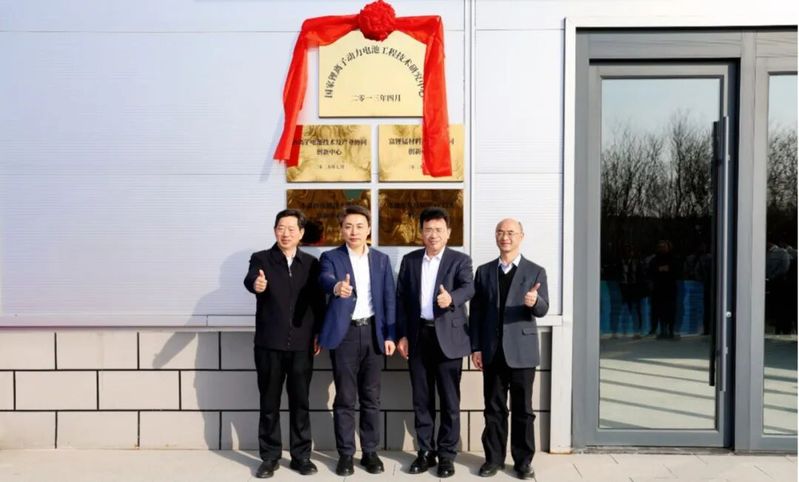
On February 6th, the first meeting of the Technical Committee of the National Engineering Research Centre for Lithium-ion Power Batteries (referred to as the National Engineering Centre) for the year 2026 was held at the headquarters of China Auto New Energy Battery Technology Co., Ltd. (referred to as China Auto New Energy). Nearly 20 industry experts attended the meeting, including Chen Jun, an academician of the Chinese Academy of Sciences, Executive Vice President of Nankai University, and Director of the Technical Committee of the National Engineering Research Center for Lithium-ion Power Batteries; Lu Tianjun, Secretary of the Party Committee and General Manager of China Auto New Energy; Qin Xingcai, Vice Chairman of the China Automotive Power Battery Industry Innovation Alliance; and Huang Yunhui, Deputy Director of the Academic Committee and Professor at Huazhong University of Science and Technology. Chen Jun, Lu Tianjun, Qin Xingcai, and Huang Yunhui jointly unveiled the plaque for the new location of the National Engineering Research Centre for Lithium-ion Power Batteries. The National Engineering Centre showcased a number of collaborative innovation achievements.
Chen Jun and Lu Tianjun jointly released an ultra-high specific energy lithium-rich manganese solid-liquid battery system product. This product was jointly developed by Academician Chen Jun's team from Nankai University and the R&D and Technology Center of China Auto New Energy. The energy density of the battery cells exceeds 500 Wh/kg, the battery pack capacity has increased by 67% year-on-year, and the driving range after installation exceeds 1,000 km.
Yan Zhenhua, a core member of the joint team and a professor at the College of Chemistry at Nankai University, stated that the team has already achieved an ultra-high specific energy solid-state battery sample with an energy density exceeding 600 Wh/kg in the laboratory. The product released this time is a mass-producible version that employs independently developed innovative materials and key technologies. The lithium-rich manganese-based cathode material is supplied by Tianjin Aiwo New Energy Co., Ltd., a company incubated by Academician Chen Jun's team from Nankai University, with a specific capacity exceeding 300 mAh/g. The energy density of the battery cells has surpassed 500 Wh/kg, which is more than twice that of high-performance lithium iron phosphate batteries. The product utilizes super-wetting in-situ solidified composite electrolyte technology independently developed by Nankai University and Tianjin Changxing New Energy Co., Ltd., offering advantages such as high ionic conductivity, super-wetting properties, a wide electrochemical window, strong interfacial affinity, flame retardancy, and low cost. Additionally, the product introduces an in-situ generated lithium anode technology for the first time, addressing the issues of high cost and high risk associated with the use of metal lithium strips, simplifying the manufacturing process, reducing production costs, and achieving significant breakthroughs in battery cycle life and safety.
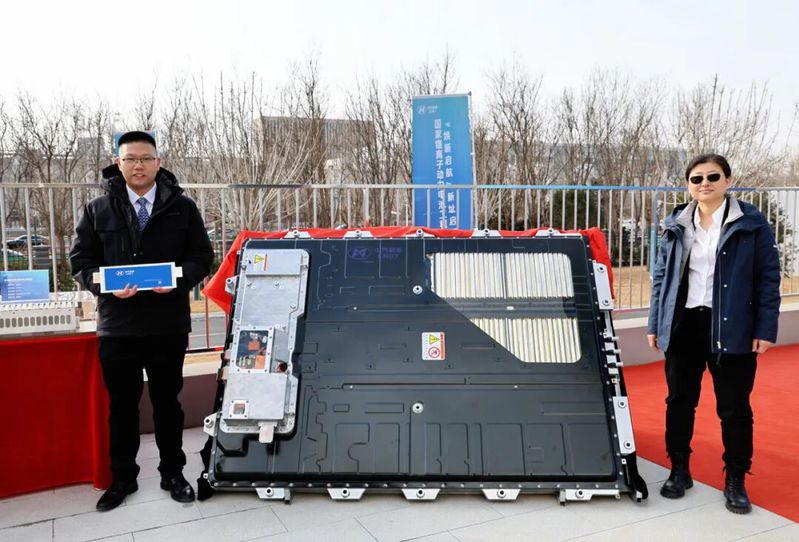
Dr. Yan Zhenhua & Dr. Li Xue
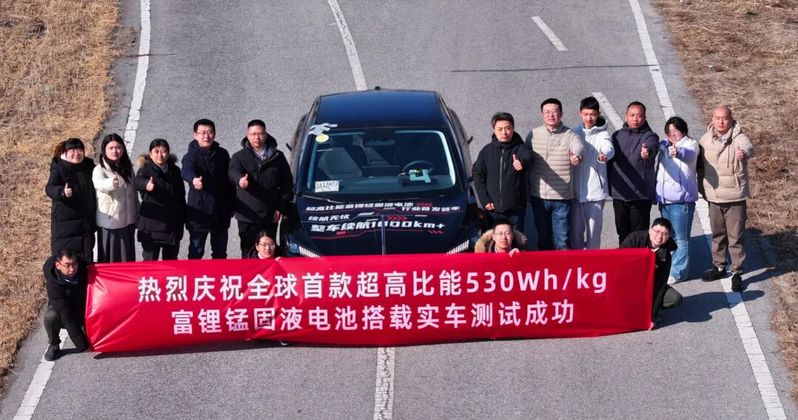
Dr. Li Xue, a core member of the joint team and a researcher at China Auto New Energy, said that the newly released battery product system has an energy density of 288 Wh/kg, with a total pack capacity of 142 kWh, enabling a driving range of over 1,000 km after installation. Moreover, the product is still undergoing iterative upgrades and is expected to achieve a battery system energy density exceeding 340 Wh/kg, a total pack capacity of over 200 kWh, and a driving range exceeding 1,600 km. The product also features an innovative thermal, electrical, mechanical, gas, and fire five-dimensional protection technology for the battery, ensuring no thermal runaway of the battery system. It is matched with vehicle-cloud collaborative battery management technology and is planned to initiate demonstration operations in 2026.
Chen Jun stated that the National Engineering Research Center for Lithium-ion Power Batteries is a crucial component of the national science and technology development plan,(shouldering the mission of implementing major national strategies and leading technological advancements in the industry. It should play a greater role in bridging basic research with industrial applications, breaking through bottleneck technologies, and resolving obstacles to the commercialization of research outcomes, thereby becoming an engine for cultivating new quality productive forces. In the future, the center will continue to be based on the coordinated development of the Beijing-Tianjin-Hebei region, playing a leading and aggregating role that extends its influence nationwide and even globally. It aims to build a collaborative innovation ecosystem integrating industry, academia, and research, further promoting battery technology innovation and industrial application, facilitating the high-quality development of the new energy industry, and making greater contributions to serving economic and social development as well as industry progress.
(Trans & edited by Xie Wei, Li Jing, Feb 11th, 2026)

Address: 94 Weijin Road, Tianjin 300071, CHINA
TEL: +86-22-2350 8470 E-mail: nkchem@nankai.edu.cn