

Prof. Chen Jun Attends the China–UK University Presidents' Dialogue and Speaks at a Thematic Session
--International Cooperation in Chemistry Continues to Deepen
**Source: Nankai University News**
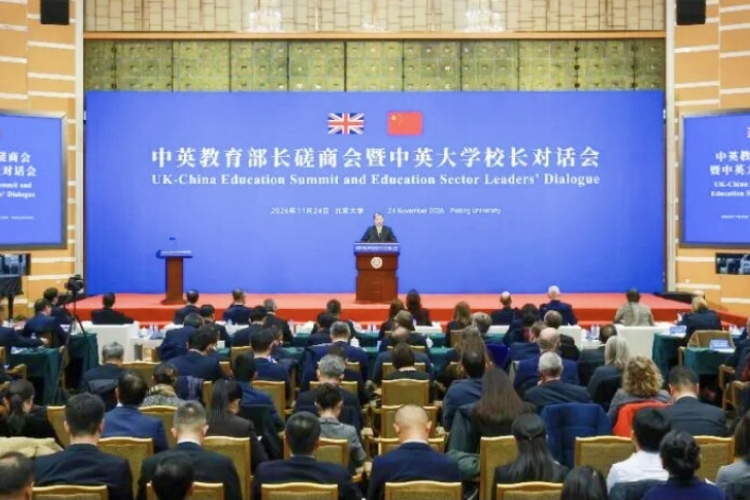
On 24 November, the China–UK University Presidents' Dialogue was held at Peking University. Huai Jinpeng, Minister of Education of China, and Lucy Powell, Secretary of State for Education of the United Kingdom, attended the opening ceremony and delivered keynote speeches. Representatives of nearly 100 universities and several institutions from both countries attended the event and exchanged views on building sustainable higher-education partnerships, talent mobility and employability, future skills, and innovation and entrepreneurship. Prof. Chen Jun, Academician of the Chinese Academy of Sciences, Executive Vice President of Nankai University and professor at the College of Chemistry, attended the event on behalf of Nankai University and spoke at the thematic session on ‘Building Sustainable Higher Education Partnerships’.
Drawing on Nankai's long years of practical experience in cooperation with UK universities, Academician Chen noted in his speech that the steady and sustained progress of this cooperation rests on trust as its foundation, a shared mission and co-created outcomes. Nankai University has now established friendly cooperative relations with 16 UK universities, including the University of Oxford, the University of Cambridge, the University of Glasgow and the London School of Economics and Political Science. Cooperation in chemistry and related disciplines has always held an important place, serving as a solid bond for research collaboration and talent development between the two sides.
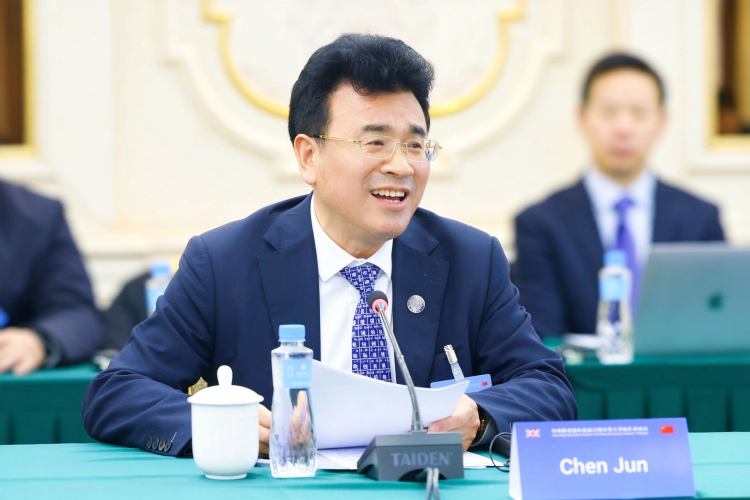
Looking to the future, Academician Chen put forward a three-point proposal. Firstly, to deepen the foundation of trust through two-way mobility by expanding faculty and student visits, exchanges and joint training. Secondly, to answer ‘the questions of our time’ through collaborative research by establishing stable mechanisms for joint research on global issues such as climate change, energy and the environment, and life and health, and by promoting jointly designed projects, jointly built platforms and shared outcomes. Thirdly, to strengthen the resilience of cooperation through regular engagement by deepening industry–education integration and the commercialisation of research results, and by jointly building an open, inclusive and trust-based education community. The proposal is highly consistent with the College of Chemistry's long-standing commitment to international research cooperation and to frontier fields such as renewable energy and green chemistry.
The chemical strength behind Nankai–Glasgow cooperation. Since Nankai University and the University of Glasgow established inter-university cooperation in 2008, the partnership has continued to deepen. In talent development, the joint graduate school co-founded by the two universities was the first set up in China by a UK university and has produced more than 850 China–UK dual degree graduates. In research cooperation, the two universities established a joint research centre in 2024, focusing on fields such as renewable energy — the very core area in which the energy chemistry team of the College of Chemistry, led by Academician Chen Jun, has long been engaged. The College's strengths in energy materials, green catalysis and environmental chemistry provide solid disciplinary support for the joint research of the two universities.
During the Dialogue, Academician Chen met with Rachel Sandison, Vice Principal of the University of Glasgow. The two sides reviewed the history of cooperation between the two universities and reached consensus on deepening cooperation, expanding joint research fields and strengthening faculty and student exchanges. The College will take this opportunity to further deepen substantive cooperation in chemistry-related disciplines with leading universities in the UK and around the world, and to contribute Nankai Chemistry's wisdom and strength to global challenges such as new energy, climate change, and life and health.
Leaders of the University's Office of International Cooperation and Exchange attended the event.
(Editor: Xie Wei)

Address: 94 Weijin Road, Tianjin 300071, CHINA
TEL: +86-22-2350 8470 E-mail: nkchem@nankai.edu.cn